Embedded insurance is changing how cover gets sold, from travel bookings to banking apps. See how Briisk’s platform powers it at the point of sale. Read more…

Ask almost any insurance executive if their legacy systems are holding them back, and you’ll get an honest “yes.” Ask them what they’re doing about it, and the answer is often much quieter.
That gap isn’t about a lack of ambition. It’s about fear. Fear of disruption, fear of cost overruns, fear of a multi-year project that stalls halfway through and leaves the business worse off than before it started.
So the legacy system stays. And the value chain, quote to policy to premium collection to claims, keeps running on infrastructure that was never built for how insurance works today.
Legacy cores and policy administration systems (PAS) were built for a different era of insurance. Many are decades old, heavily customised over the years, and deeply embedded in day-to-day operations. That’s exactly what makes them so hard to leave.
✅ Underwriting still relies on manual checks and back-and-forth data gathering in a lot of organisations
✅ Policy administration is often split across multiple systems that don’t talk to each other well
✅ Premium collection processes are manual or semi-manual, creating friction and delays
✅ Product teams need months, not weeks, to launch anything new
None of this is a surprise to anyone working inside an insurer. What’s harder to solve is the assumption that fixing it means tearing the whole system out and starting again.
Every quarter an insurer delays modernising, the gap between what customers expect and what the business can deliver gets a little wider.
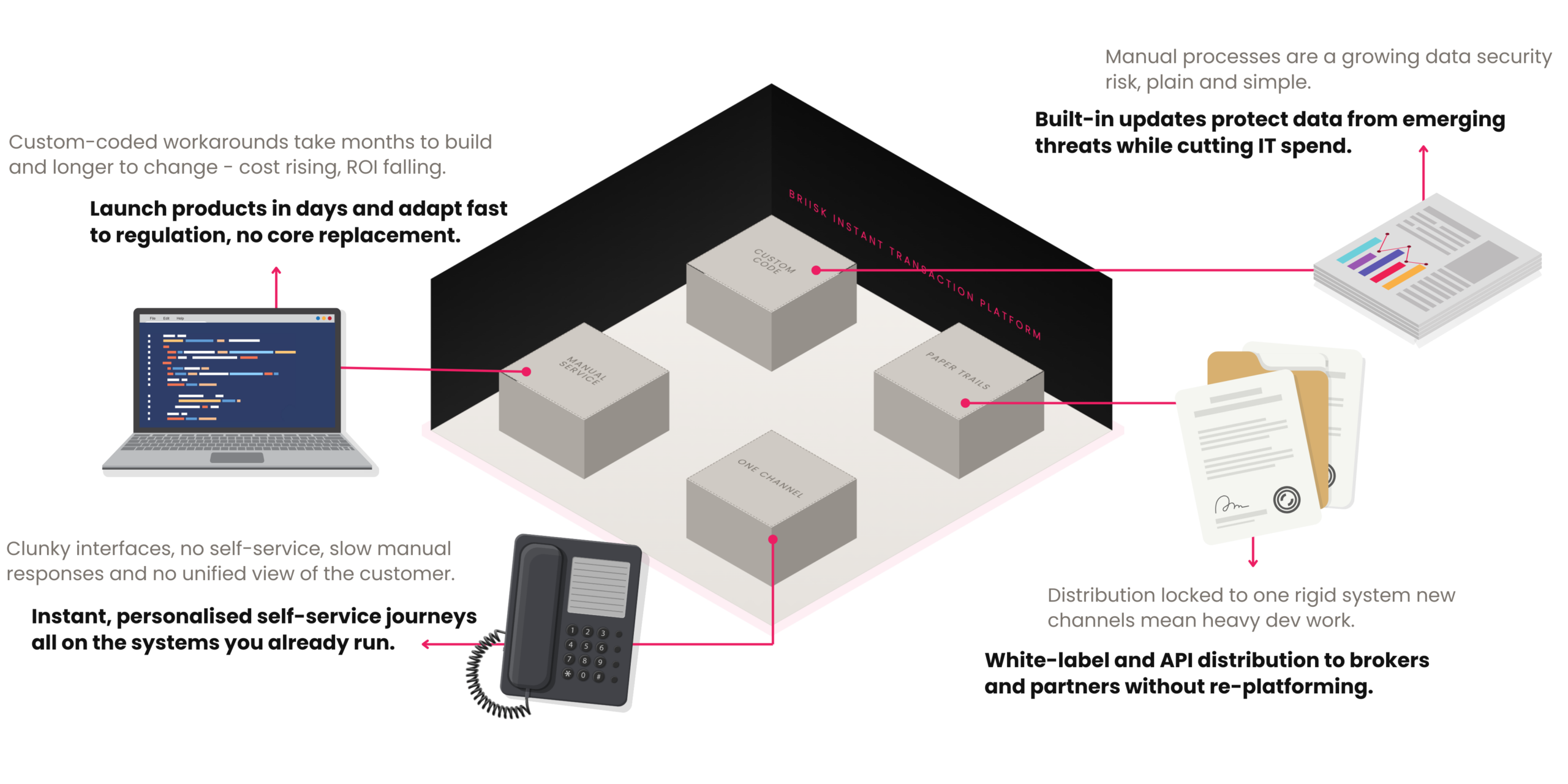
Internally, that shows up as slower product launches, more manual admin work, and teams spending time reconciling data between systems instead of improving the business. Externally, it shows up as friction: policyholders waiting longer than they should, clunky digital journeys, and a customer experience that feels dated compared to almost every other industry they interact with.
Basically, the cost of inaction isn’t standing still. It’s falling further behind, one manual process at a time.
Here’s the shift happening across the industry: insurers are realising that digital transformation doesn’t have to mean replacing the core system.
Instead, more organisations are layering modern, cloud-based tools on top of their existing infrastructure. Rather than a multi-year rebuild with an uncertain outcome, this approach connects into what’s already there, whether that’s a legacy PAS, a homegrown system, or something built for a different market decades ago, and starts digitising the parts of the value chain that need it most.
This is a meaningfully different proposition for risk-averse, legacy-heavy organisations. It turns modernisation from an all-or-nothing bet into a series of manageable, lower-risk steps.
When the pieces come together properly, the value chain stops feeling like a series of disconnected systems and starts working as one continuous flow.
✅ Product configuration that lets teams launch and adjust insurance products without a full development cycle
✅ Policy administration that runs consistently, without the reconciliation work that comes from split systems
✅ Workflow automation that removes repetitive manual steps across the process
✅ Premium collection that runs smoothly instead of relying on manual follow-up
✅ Reporting and analytics that give teams real visibility into what’s actually happening, instead of static, delayed snapshots
✅ API integrations that keep everything connected to the systems already in place
The value comes from working with what’s already in place, adding a layer that connects and digitises the process rather than starting from a blank slate.

This is exactly the gap Briisk ITP (Briisk Instant Transaction Platform) is built to close. It’s a configurable, cloud-based platform that supports the full insurance lifecycle, from product launch and policy administration to premium collection, and it’s built to work alongside existing core and PAS systems rather than requiring insurers or brokers to replace them.
For insurance executives, digital transformation leads, and product teams sitting on legacy infrastructure, that’s the practical difference. You don’t need to choose between staying put and a disruptive overhaul. You can start digitising the value chain now, on top of what you already have.
If this is a thought you’ve had, book a demo to see how Briisk ITP fits alongside your existing systems, or how it will become the only system you need.
Embedded insurance is changing how cover gets sold, from travel bookings to banking apps. See how Briisk’s platform powers it at the point of sale. Read more…
Insurers are realising that digital transformation doesn’t have to mean replacing the core system. Instead, more organisations are layering modern, cloud-based tools on top of their existing infrastructure, connecting into what’s already there and digitising the parts of the value chain that need it most. This turns modernisation from an all-or-nothing bet into a series of manageable, lower-risk steps.
How insurance businesses can prepare for AI adoption: A practical roadmap for digitisation, automation & upskilling: A practical roadmap for brokers, insurers, underwriters and UMAs looking to digitise operations, automate workflows and use AI effectively.
For years, industry headlines have predicted the decline of the insurance broker. With the rise of direct-to-consumer platforms and digital insurers, the assumption was that intermediaries would eventually disappear. Yet brokerages have proven remarkably resilient. The reality is that brokers are not disappearing. They are evolving. The real question is not whether brokers survive but […]
The state of the industry As the insurance industry enters 2026, InsurTech stands at a pivotal moment. The past year marked a transition from rapid experimentation to a more disciplined focus on results. In 2025, insurers faced mounting pressures — rising premiums, increased climate-related losses, growing cyber threats and tighter capital conditions — all while […]
Insurance may appear simple on the surface; a quote, a premium, a policy, a claim – but beneath that simplicity sits a dense web of processes, rules, data, and compliance requirements. That’s where the Policy Administration System (PAS) steps in: the engine room of an insurance business. Whether you’re a carrier, MGA, or digital broker, […]
In the insurance world, missed premium payments might seem like a small issue — a single debit order that fails, a forgotten reminder, or a late salary run. But when scaled across a portfolio, the impact is anything but small. For insurers, brokers, and UMA’s, missed payments disrupt cash flow, increase administrative workload, and threaten […]
Drafting business requirements is one of the most time-consuming yet critical parts of any technology project. It’s where ideas turn into structure, where “what we want” becomes “what we need to build.” But anyone who’s been through the process knows: it can be messy, repetitive, and full of back-and-forths. This is where Artificial Intelligence (AI) […]
Artificial Intelligence (AI) is no longer just a futuristic buzzword — it’s here, shaping how industries operate, innovate, and grow. In insurance, where efficiency and accuracy are critical, AI has the potential to transform every step of the value chain, from product design and marketing to claims management and training. But while many talk about […]
Personalisation and decision support through a digitised broker platform “There are so many options… how do I know what’s right for me?” It’s one of the most common — and paralysing — questions for insurance customers. Whether they’re 21 or 51, navigating product choices can be overwhelming, especially when financial literacy is low and the […]