Embedded insurance is changing how cover gets sold, from travel bookings to banking apps. See how Briisk’s platform powers it at the point of sale. Read more…


Insurance may appear simple on the surface; a quote, a premium, a policy, a claim – but beneath that simplicity sits a dense web of processes, rules, data, and compliance requirements. That’s where the Policy Administration System (PAS) steps in: the engine room of an insurance business.
Whether you’re a carrier, MGA, or digital broker, the PAS is no longer just a back-office tool. It’s become the primary platform that shapes efficiency, customer experience, and the ability to innovate at pace. Let’s break down what a PAS is, why it matters, and how it’s reshaping the way insurance products are built, managed, and accessed.
A Policy Administration System is specialised software that handles everything required to manage the full lifecycle of an insurance policy — from the moment a quote is created, all the way to renewal or cancellation.
At its core, a PAS performs the operational heavy lifting:
Historically, these tasks relied on paper files, human calculations, or aging mainframe systems. Modern insurance simply can’t run that way — the volume, complexity, and regulatory expectations are too high.
A PAS provides:
✅ One single source of truth for customer and policy information
✅ Automation of repetitive tasks, reducing error rates and workload
✅ Real-time access across departments, improving operational flow
✅ A centralised operational brain, especially for MGAs and intermediaries administering policies for carriers
Without a PAS, an insurer can’t scale, innovate, or deliver the level of service customers expect today.
Calling today’s systems “policy admin” is a bit like calling an iPhone a “telephone” — technically true, but wildly understated. Modern PAS platforms have evolved far beyond basic policy administration — they now sit at the centre of digital transformation. They’re expected to support speed-to-market, flexible product configuration, embedded distribution, compliance, data transparency, and seamless integration across ecosystems.
Over the last decade, PAS platforms evolved from basic databases into full end-to-end digital insurance ecosystems, offering:
Where Briisk fits in:
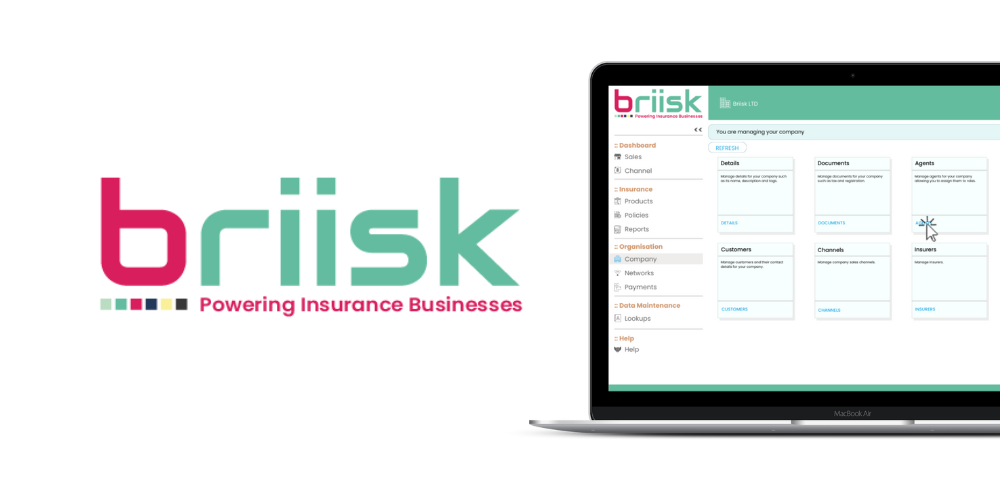
Briisk’s Instant Transaction Platform (BITP) actually satisfies many of the expectations traditionally placed on modern PAS platforms — but with a crucial twist. Instead of trying to replace a carrier’s entire core stack, Briisk gives brokers and insurers the distribution-layer power they need:
✅ Rapid product digitisation without code
✅ A cloud-native platform tuned for high-volume, low-touch distribution
✅ Real-time policy lifecycle management for digital channels
✅ An integration-friendly environment that plugs into existing PAS/legacy systems
✅ Data visibility and workflow automation that unlock new revenue opportunities
✅ Full compliance and audibility baked in
Basically… Briisk covers the front-end digital experience, automation, and distribution capability that modern PAS platforms promise — without forcing insurers to rip out their core systems. It plays beautifully with legacy stacks while giving brokers the digital muscle they’ve been missing.
A modern PAS isn’t just supporting administration — it’s enabling insurers to launch new products faster, automate underwriting decisions, build omni-channel customer journeys, and collaborate with specialist insurtech tools.
In the insurance world, there’s a lot of pressure to pick an “all-in-one” system that claims to do everything — policy admin, claims, billing, payments, product configuration, distribution, customer servicing, the works. Sounds convenient… but in reality these platforms often become:
The industry is shifting away from that mindset.
Modern digital ecosystems now favour a best-of-breed approach — pairing specialised platforms that each excel at a specific layer of the value chain.
Instead of trying to replace an insurer’s PAS or compete as a massive “all-in-one,” Briisk intentionally positions itself as a high-performance, best-of-breed distribution and automation layer. It works alongside existing core systems, giving brokers and MGAs the digital muscle traditional PAS platforms struggle to deliver:
This approach lets insurers and brokers keep their stable core systems while adding the modern digital capabilities they actually need to prevent missed payments and scale distribution — without the pain of a full system replacement.
A well-designed PAS supports the full policy lifecycle, including:
✅ Quoting & underwriting: Captures risk information, applies rating rules, and helps underwriters evaluate and price policies accurately.
✅ Policy issuance: Produces compliant contracts, certificates, and schedules instantly once cover is bound.
✅ Mid-term changes (endorsements): Updates policy details, recalculates premiums, and issues new documents automatically.
✅ Renewals: Identifies expiring policies, generates renewal terms, and tracks acceptances, dramatically reducing manual workload.
✅ Cancellations: Handles terminations, calculates return premiums, and ensures proper notification and record accuracy.
✅ Billing & payments: Manages premium schedules, instalments, arrears, and reconciliation — all tightly linked to policy status.
✅ Claims integration: Shares coverage data with claims platforms, helping validate claims and keep customer info consistent.
✅ Compliance: Enforces underwriting authority limits, embeds required disclosures, and maintains audit trails.
✅ Reporting & analytics: Provides dashboards, performance metrics, portfolio insights, regulatory reports, and more.
With the rise of cloud-native PAS platforms, these capabilities are now accessible even to small and mid-sized intermediaries — not just large carriers.
Modern customers expect convenience, transparency, and control — and a PAS plays a critical role by enabling insurance self-service portals.
What is an insurance self-service portal?
A self-service portal is a digital interface where policyholders can:
These portals are made possible because the PAS provides real-time data and automated processes behind the scenes.
How self-service improves customer experience:
💬 24/7 accessibility
Customers no longer need to wait for business hours or call-centre queues. Everything is available instantly.
⚡ Speed
Endorsements, document downloads, and quotes happen in minutes.
💸 Billing clarity
Transparent statements, easy payments, and immediate premium updates reduce confusion.
🔒 Accuracy and trust
Customers see exactly what coverage they have. No surprises later.
📱 Digital convenience
Portals can be integrated with apps, chatbots, or embedded insurance journeys.
For insurers, the benefits are equally strong:
Self-service isn’t about replacing people — it’s about giving customers effortless access while freeing staff to focus on higher-value interactions.
Insurance is evolving quickly, and the PAS is at the centre of this transformation.
Expect to see continued growth in:
✅ AI-driven underwriting & claims automation
PAS platforms will increasingly orchestrate AI decisioning tools.
✅ Embedded insurance & partnerships
APIs will extend product distribution far beyond traditional channels.
✅ Hyper-personalised products
Real-time data + flexible product builders = tailored coverage.
✅ No-code product configuration
Business users creating products in hours, not IT projects in months.
✅ Customer-centric system design
Policies organised around customers rather than products or accounts.
The insurers who thrive will be the ones with modern core systems that can adapt at speed.
A modern PAS isn’t just the “back-office system” of old. It’s:
For carriers, MGAs, brokers, and digital intermediaries, investing in a modern PAS means building a scalable, future-proof foundation for growth.
👉 Book a demo today: https://www.briisk.io/demo/
Embedded insurance is changing how cover gets sold, from travel bookings to banking apps. See how Briisk’s platform powers it at the point of sale. Read more…
Insurers are realising that digital transformation doesn’t have to mean replacing the core system. Instead, more organisations are layering modern, cloud-based tools on top of their existing infrastructure, connecting into what’s already there and digitising the parts of the value chain that need it most. This turns modernisation from an all-or-nothing bet into a series of manageable, lower-risk steps.
How insurance businesses can prepare for AI adoption: A practical roadmap for digitisation, automation & upskilling: A practical roadmap for brokers, insurers, underwriters and UMAs looking to digitise operations, automate workflows and use AI effectively.
For years, industry headlines have predicted the decline of the insurance broker. With the rise of direct-to-consumer platforms and digital insurers, the assumption was that intermediaries would eventually disappear. Yet brokerages have proven remarkably resilient. The reality is that brokers are not disappearing. They are evolving. The real question is not whether brokers survive but […]
The state of the industry As the insurance industry enters 2026, InsurTech stands at a pivotal moment. The past year marked a transition from rapid experimentation to a more disciplined focus on results. In 2025, insurers faced mounting pressures — rising premiums, increased climate-related losses, growing cyber threats and tighter capital conditions — all while […]
Insurance may appear simple on the surface; a quote, a premium, a policy, a claim – but beneath that simplicity sits a dense web of processes, rules, data, and compliance requirements. That’s where the Policy Administration System (PAS) steps in: the engine room of an insurance business. Whether you’re a carrier, MGA, or digital broker, […]
In the insurance world, missed premium payments might seem like a small issue — a single debit order that fails, a forgotten reminder, or a late salary run. But when scaled across a portfolio, the impact is anything but small. For insurers, brokers, and UMA’s, missed payments disrupt cash flow, increase administrative workload, and threaten […]
Drafting business requirements is one of the most time-consuming yet critical parts of any technology project. It’s where ideas turn into structure, where “what we want” becomes “what we need to build.” But anyone who’s been through the process knows: it can be messy, repetitive, and full of back-and-forths. This is where Artificial Intelligence (AI) […]
Artificial Intelligence (AI) is no longer just a futuristic buzzword — it’s here, shaping how industries operate, innovate, and grow. In insurance, where efficiency and accuracy are critical, AI has the potential to transform every step of the value chain, from product design and marketing to claims management and training. But while many talk about […]
Personalisation and decision support through a digitised broker platform “There are so many options… how do I know what’s right for me?” It’s one of the most common — and paralysing — questions for insurance customers. Whether they’re 21 or 51, navigating product choices can be overwhelming, especially when financial literacy is low and the […]