Insurers focus on claims once they’re filed, but many are lost before that, at First Notice of Loss (FNOL). Here’s why automating FNOL is the fastest way to fix insurance’s non-claiming problem.


This interview with our founder and joint CEO Hanno van Aarde is about the challenges that brokers face in the digital age and solutions to bring about digital transformation. We are especially looking at how due to the COVID-19 pandemic and the ensuing lockdowns the modern insurance broker has to find digital ways of how to sell insurance.
The impact is particularly strong in sales: With the lockdowns of COVID-19, from one day to the other, they couldn’t have physical meetings with their customers anymore and didn’t have workflows in place to support digital distribution. Many of the processes of brokers are manual. So you would see agents – or point of sale persons, how we call them, working the field with manual forms. They would then bring the manual forms to the office where they would enter the consumer data into legacy systems. In some markets, like the US and Hong Kong, the regulation even requires physical signatures.
Moreover, the requirement to work on-site due to outdated infrastructure is also a huge challenge for brokers. These legacy systems are not only old, but also slow and costly. As a result, we are seeing low productivity levels with brokers, especially in emerging markets such as India, Africa and Asia.
To put it simply: Customers expect to buy their insurance online by now. Academics refer to the point of mass adoption as the tipping point – the stage of development beyond which there is no going back and when all customers expect to buy insurance online. This was famously explained in Malcolm Gladwell’s book The Tipping Point: “The tipping point is that magic moment when an idea, trend, or social behavior crosses a threshold, tips, and spreads like wildfire. Unquestionably, the 2020 crisis will accelerate the world to the tipping point for digital adoption, as illustrated by the digital insurer:
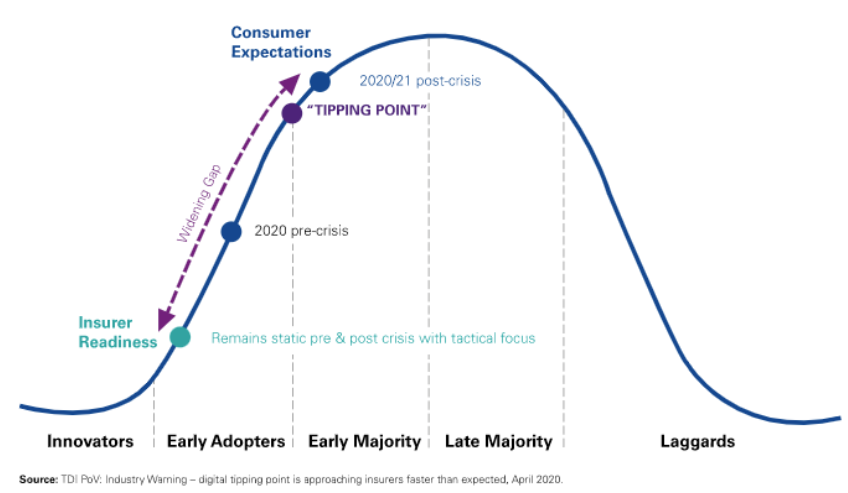
Insurers and brokers have to act now and digitise their business in order to meet customer expectations and avoid InsurTechs chowing up their customer base and revenues.
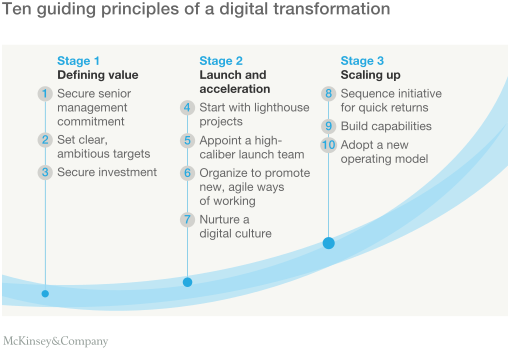
McKinsey did a great research on this that I like to refer to. They summed up ten guiding principles of digital transformation, structured in three phases:
When driving digital transformation forward we are seeing that change always comes with a “Who moved my cheese” mindset. Once, the original cheese – in this case revenue – starts disappearing, there will be people that will very quickly “put on their jogging shoes” and move on to a new approach and another set of people for whom it won’t be that easy and who will wait for “the same cheese” to be presented to them on a silver platter. As Spencer Johnson explains in his classic book about change management “Who Moved my cheese?”:
“The quicker you let go of old cheese, the sooner you find new cheese.”
– Spencer Johnson
We are also seeing low levels of digital skills and an understanding of operating models. For instance, just putting existing products on to a digital consumer front-end won’t sell insurance. You have to create unique and competitive insurance products due to increased transparency online and you have to build strong brands online and apply online advertising budgets to attracting consumers to your website to achieve conversion.
At Briisk we have a Broker solution where the Broker is in the centre – connected to Insurers, Distribution and Customers via the Briisk Instant Transaction Platform or Briisk ITP.
Insurers focus on claims once they’re filed, but many are lost before that, at First Notice of Loss (FNOL). Here’s why automating FNOL is the fastest way to fix insurance’s non-claiming problem.
Embedded insurance is changing how cover gets sold, from travel bookings to banking apps. See how Briisk’s platform powers it at the point of sale. Read more…
Insurers are realising that digital transformation doesn’t have to mean replacing the core system. Instead, more organisations are layering modern, cloud-based tools on top of their existing infrastructure, connecting into what’s already there and digitising the parts of the value chain that need it most. This turns modernisation from an all-or-nothing bet into a series of manageable, lower-risk steps.
How insurance businesses can prepare for AI adoption: A practical roadmap for digitisation, automation & upskilling: A practical roadmap for brokers, insurers, underwriters and UMAs looking to digitise operations, automate workflows and use AI effectively.
For years, industry headlines have predicted the decline of the insurance broker. With the rise of direct-to-consumer platforms and digital insurers, the assumption was that intermediaries would eventually disappear. Yet brokerages have proven remarkably resilient. The reality is that brokers are not disappearing. They are evolving. The real question is not whether brokers survive but […]
The state of the industry As the insurance industry enters 2026, InsurTech stands at a pivotal moment. The past year marked a transition from rapid experimentation to a more disciplined focus on results. In 2025, insurers faced mounting pressures — rising premiums, increased climate-related losses, growing cyber threats and tighter capital conditions — all while […]
Insurance may appear simple on the surface; a quote, a premium, a policy, a claim – but beneath that simplicity sits a dense web of processes, rules, data, and compliance requirements. That’s where the Policy Administration System (PAS) steps in: the engine room of an insurance business. Whether you’re a carrier, MGA, or digital broker, […]
In the insurance world, missed premium payments might seem like a small issue — a single debit order that fails, a forgotten reminder, or a late salary run. But when scaled across a portfolio, the impact is anything but small. For insurers, brokers, and UMA’s, missed payments disrupt cash flow, increase administrative workload, and threaten […]
Drafting business requirements is one of the most time-consuming yet critical parts of any technology project. It’s where ideas turn into structure, where “what we want” becomes “what we need to build.” But anyone who’s been through the process knows: it can be messy, repetitive, and full of back-and-forths. This is where Artificial Intelligence (AI) […]
Artificial Intelligence (AI) is no longer just a futuristic buzzword — it’s here, shaping how industries operate, innovate, and grow. In insurance, where efficiency and accuracy are critical, AI has the potential to transform every step of the value chain, from product design and marketing to claims management and training. But while many talk about […]